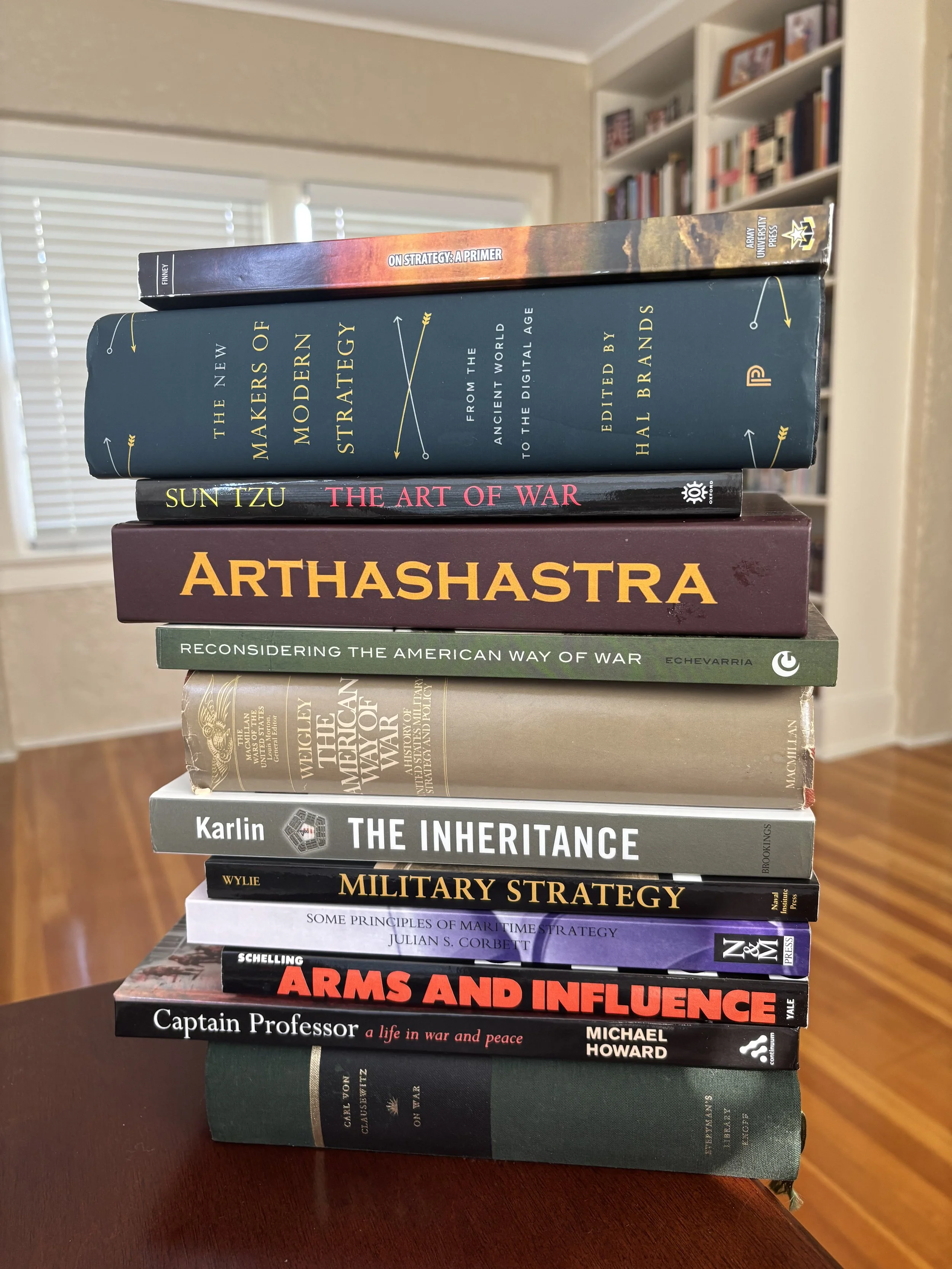
Reading Strategy
After more than a decade away from studying the fundamentals of what our new Army strategist officers (Functional Area 59, or FA59) are taught in the Basic Strategic Art Program (BSAP) at the US Army War College, I’m diving back in at my own pace. The below is a chronicle of the readings, if you want to follow along.
Note: I’ll post the major readings, but there are a host of other items that add flavor and nuance to the basic syllabus that won’t be covered here.
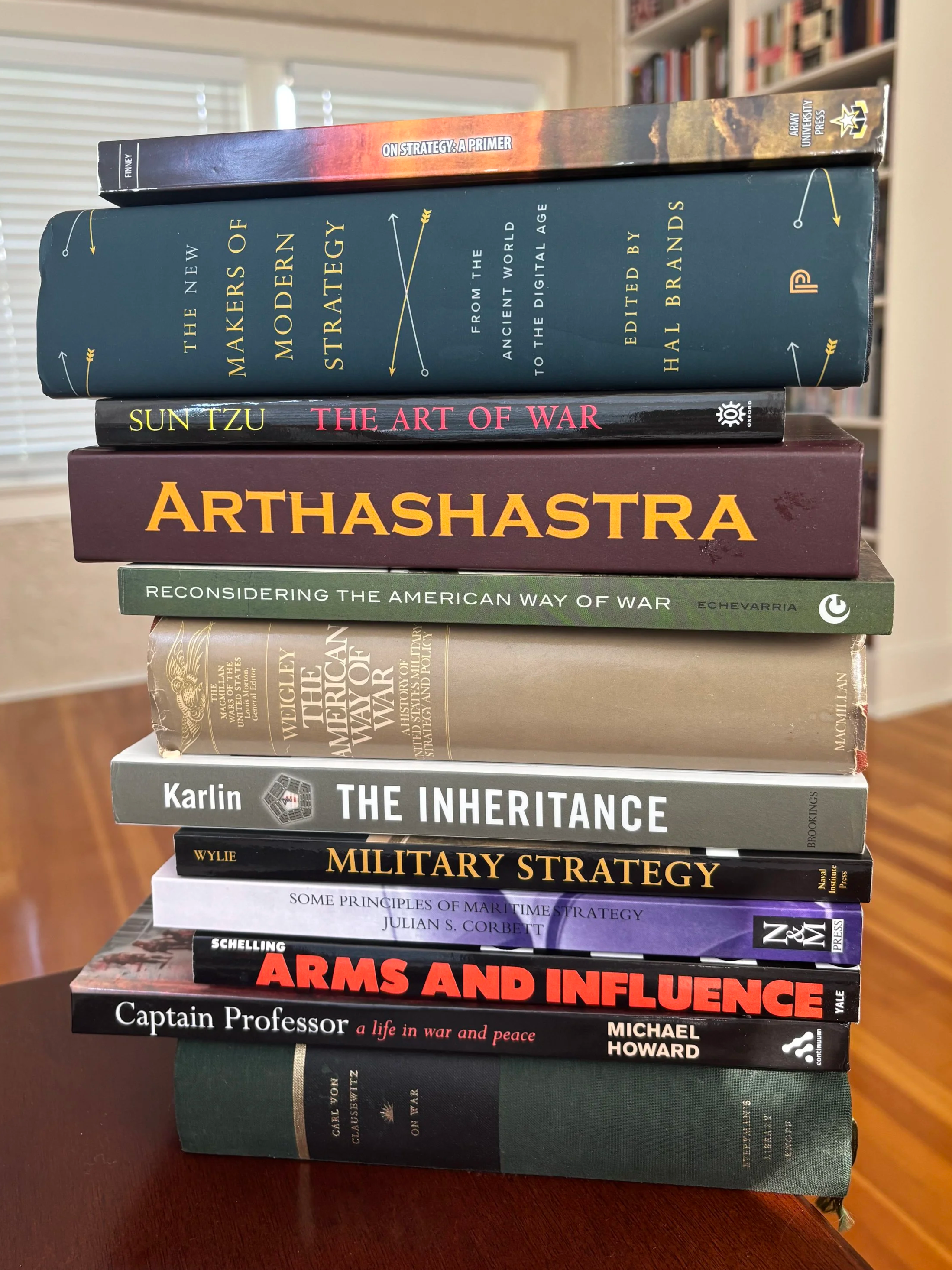
Week 1 - Foundations
Nathan K. Finney, On Strategy: A Primer - focus on J.P. Clark and Francis Park, “Practical Strategists: The Perspective and Craft of the General Staff Officer,” pp. 115-126.
Hal Brands, The New Makers of Modern Strategy: From the Ancient World to the Digital Age - focus on Lawrence Freedman, “Strategy: The History of an Idea,” pp. 17-40.
Week 2 - “Non-Western” Strategy
Hal Brands, The New Makers of Modern Strategy: From the Ancient World to the Digital Age - focus on Toshi Yoshihara, “Sun Zi and the Search for a Timeless Logic of Strategy.”
John Sullivan, “Sun Tzu’s Fighting Words,” Strategy Bridge.
Sun Tzu, The Art of War, trans. by Samuel B. Griffith - focus on pp. 63-110 and 144-149.
Kautilya, The Arthashastra, trans. by R. Shamasastry - focus on pp. 101-114, 119-120, 137-145, 158-163.
Week 3 - “Western” Strategy
Hal Brands, The New Makers of Modern Strategy: From the Ancient World to the Digital Age - focus on Hew Strachan, “The Elusive Meaning and Enduring Relevance of Clausewitz.”
Carl von Clausewitz, On War, trans. by Michael Howard and Peter Paret - focus on pp. 479-483, 74-104, 113-123, 357-371, 524-529, 566-573, 579-600, 605-610.
Hal Brands, The New Makers of Modern Strategy: From the Ancient World to the Digital Age - focus on Walter Russell Mead, “Thucydides, Polybius, and the Legacies of the Ancient World.”
Thucydides, The Peloponnesian War, trans. Walter Blanco - focus on pp. 1.22-1.23, 1.66-1.88, 5.84-5.116, 1.140-1.146 and 2.54-2.56, 5.14-5.31, 6.8-6.26 and 8.1-8.2.
Week 4 - Coercion theory
Thomas Schelling, Arms and Influence, Focus on, pp. 1-18, 35-43, 69-91.
Glenn Snyder, “Deterrence and Power,” Journal of Conflict Resolution, 4 (1960), pp. 163-178.
Robert Pape, Bombing to Win: Air Power and Coercion in War - focus on pp. 12-38.
Joint Publication 1, Vol 1, “Strategic Uses of Force,” - focus on pp. I-3 to I-5.
Matthew Jackson and Massimo Morelli, “The Reasons for War: An Updated Survey,” In The Handbook on the Political Economy of War, eds. Christopher J. Coyne and Rachel L. Mathers - pp. 34-57.
Michael Mazarr, Understanding Deterrence.
Lyle Morris, “China’s Views on Escalation and Crisis Management and Implications for the United States,” Asia Society Policy Institute (22 January 2025).
Erika Solomon, “For Iran’s Rulers, Refusing U.S. Demands is a Risk Worth Taking, New York Times (23 February 2026).
Week 5 - Other Theories of Strategy (incl. Maritime and Air)
Basil H. Liddell Hart, Strategy, pp. xvii-xxi, 319-360.
Arthur F. Lykke,, “Defining Military Strategy: S = E + W + M.” Military Review 69, no. 5 (May 1989).
Frank G. Hoffman, “The Missing Element in Crafting National Strategy: A Theory of Success.” JFQ 97 (2nd Qtr 2020): 55-64.
Lawrence Freedman, Strategy: A History, pp. 607-629.
Ian T. Brown, A New Conception of War: John Boyd, the U.S. Marines, and Maneuver Warfare, pp. 90-98.
Dmitry Plotnikov, “Still Misreading Svechin: Annihilation, Attrition, and Their Strategic and Operational Implications.” Journal of Military History 86 (July 2022): 670-687.
Rupert Smith, The Utility of Force: The Art of War in the Modern World, pp. 3-28.
Michael Howard, Captain Professor: The Memoirs of Sir Michael Howard, pp. 154-155.
Jacob L. Heim, Zachary Burdette, and Nathan Beauchamp-Mustafanga, U.S. Military Theories of Victory for a War with the People’s Republic of China. Corporation.
Lawrence Freedman, “The Age of Forever Wars: Why Military Strategy No Longer Delivers Victory.” Foreign Affairs 104, No. 5 (May/June 2025): 108-121.
Alfred Thayer Mahan, Mahan on Naval Warfare, ed. Allan Westcott, pp.16-74.
Julian S. Corbett, Some Principles of Maritime Strategy, pp. 91-106, 155-161.
J.C. Wylie, Military Strategy: A General Theory of Power Control, pp. 22-27, 32-55, 74-83.
U.S. Space Force, Space Warfighting: A Framework for Planners.
Giulio Douhet, Extracts from “The Probable Aspects of the War of the Future,” in The Command of the Air.
John A. Warden, “The Enemy as a System.” Airpower Journal 9, no. 1 (Spring 1995): 42-55
Robert A. Pape, Bombing to Win: Air Power and Coercion in War, pp. 55-86, 314-331.
Harry Davies, Bethan McKernan, and Dan Sabbagh, “‘The Gospel’: How Israel Uses AI to Select Bombing Targets in Gaza,” The Guardian, 1 December 2023.
Russell F. Weigley, A Great Civil War: A Military and Political History, 1861-1865, pp. 210-241, 256-270.
Week 6 - Nuclear, InSurgent, Irregular, Hybrid, and Civil War
Hal Brands, The New Makers of Modern Strategy: From the Ancient World to the Digital Age - focus on Hew Strachan, “The Elusive Meaning and Enduring Relevance of Clausewitz.” - focus on Eric Edelman, “Nuclear Strategy in Theory and Practice: The Great Divergence,” pp. 665-691.
Thomas C. Schelling, Arms and Influence.
Robert A. Pape, Bombing to Win: Air Power and Coercion in War.
U.S. Department of Defense, Report on the Nuclear Employment Strategy of the United States, 7 November 2024.
Anya L. Fink, “Nuclear-Armed Sea-Launched Cruise Missile (SLCM-N).” Congressional Research Service, 12 February 2025.
Hal Brands, The New Makers of Modern Strategy: From the Ancient World to the Digital Age - focus on Francis J. Gavin, “The Elusive Nature of Nuclear Strategy.”
Hal Brands, The New Makers of Modern Strategy: From the Ancient World to the Digital Age - focus on Thomas G. Mahnken, “Arms Competition, Arms Control, and Strategies of Peacetime Competition from Fisher to Reagan.”
Richard B. Frank, Tower of Skulls: A History of the Asia-Pacific War, July 1937-May 1942.
Mao Tse-tung, Selected Military Writings of Mao Tse-Tung, pp. 206-263.
Stathis N. Kalyvas, “The Ontology of ‘Political Violence’: Action and Identity in Civil Wars,” Perspectives on Politics 1 (2003): 475-494.
Frank G. Hoffman, Conflict in the 21st Century: The Rise of Hybrid Wars.
T.E. Lawrence, 27 Articles.
Department of Defense Instruction 3000.07, Irregular Warfare, 29 September 2025.
Michael N. Nagata and Austin Carson, “Secret Wars: Covert Action and Irregular Wafare,” Irregular Warfare Podcast, 7 March 2024, https://irregularwarfare.org/podcasts/secret-wars-covert-action-and-irregular-warfare/.
David W. Hogan, Jr., U.S. Army Special Operations in World War II.
Mara E. Karlin, The Inheritance: America’s Military After Two Decades of War.
Hal Brands, The New Makers of Modern Strategy: From the Ancient World to the Digital Age - focus on Carter Malkasian, “Strategies of Counterinsurgency and Counter-Terrorism after 9/11,” pp. 918-945.
Joel Rayburn and Frank Sobchak, eds. “Conclusions,” in The U.S Army in the Iraq War, Vol. 2: Surge and Withdrawal.
Ed Butler, “Setting Ourselves Up for a Fall in Afghanistan,” RUSI Journal 160 (March 2015): 46-57.
Jonathan Hackett and Sandor Fabian, “Theory vs Practice: What is Irregular War?” Irregular Warfare Podcast, 10 January 2025, https://irregularwarfare.org/podcasts/theory-vs-practice-what-is-irregular-war/.