Reading Strategy
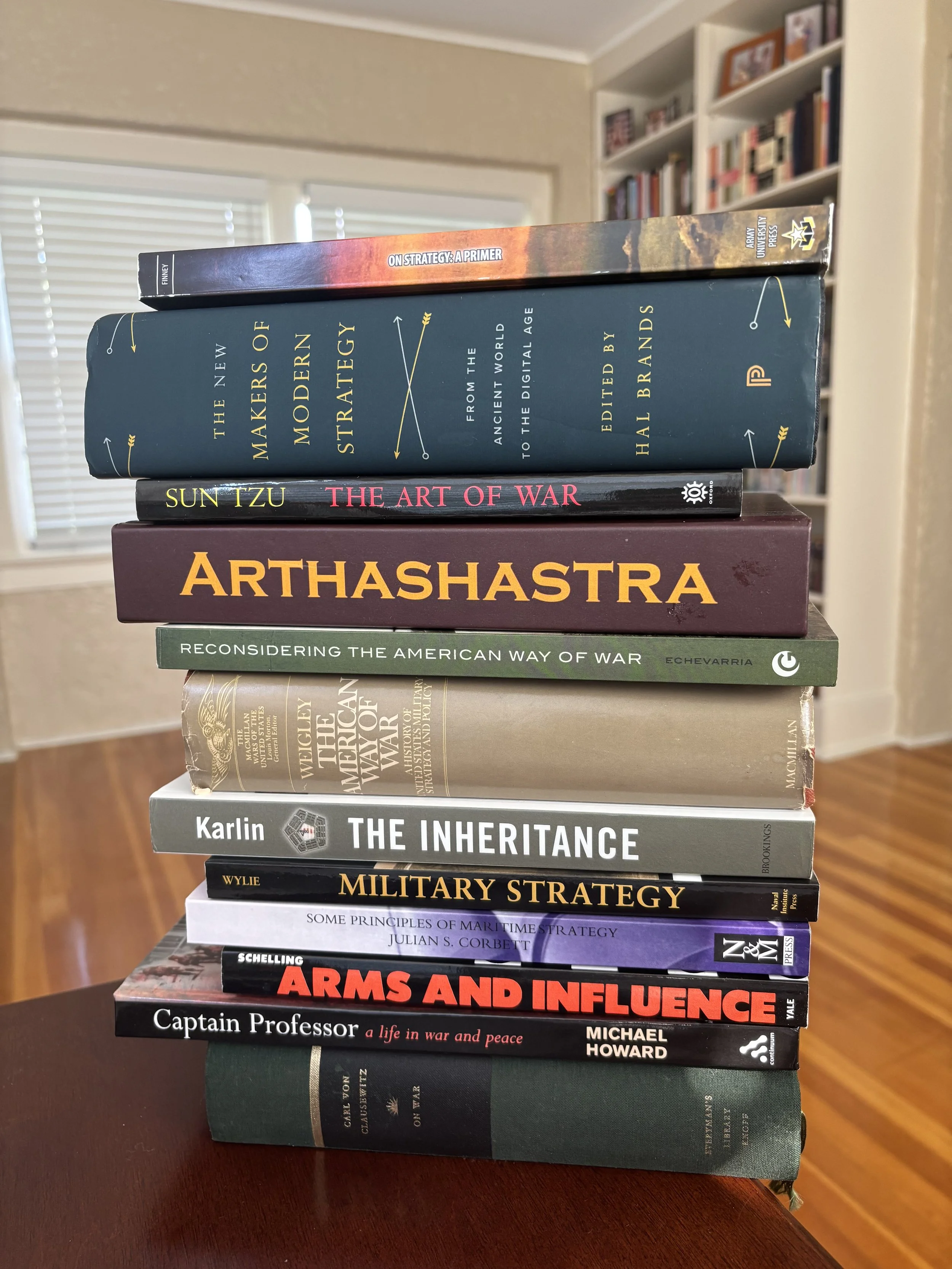
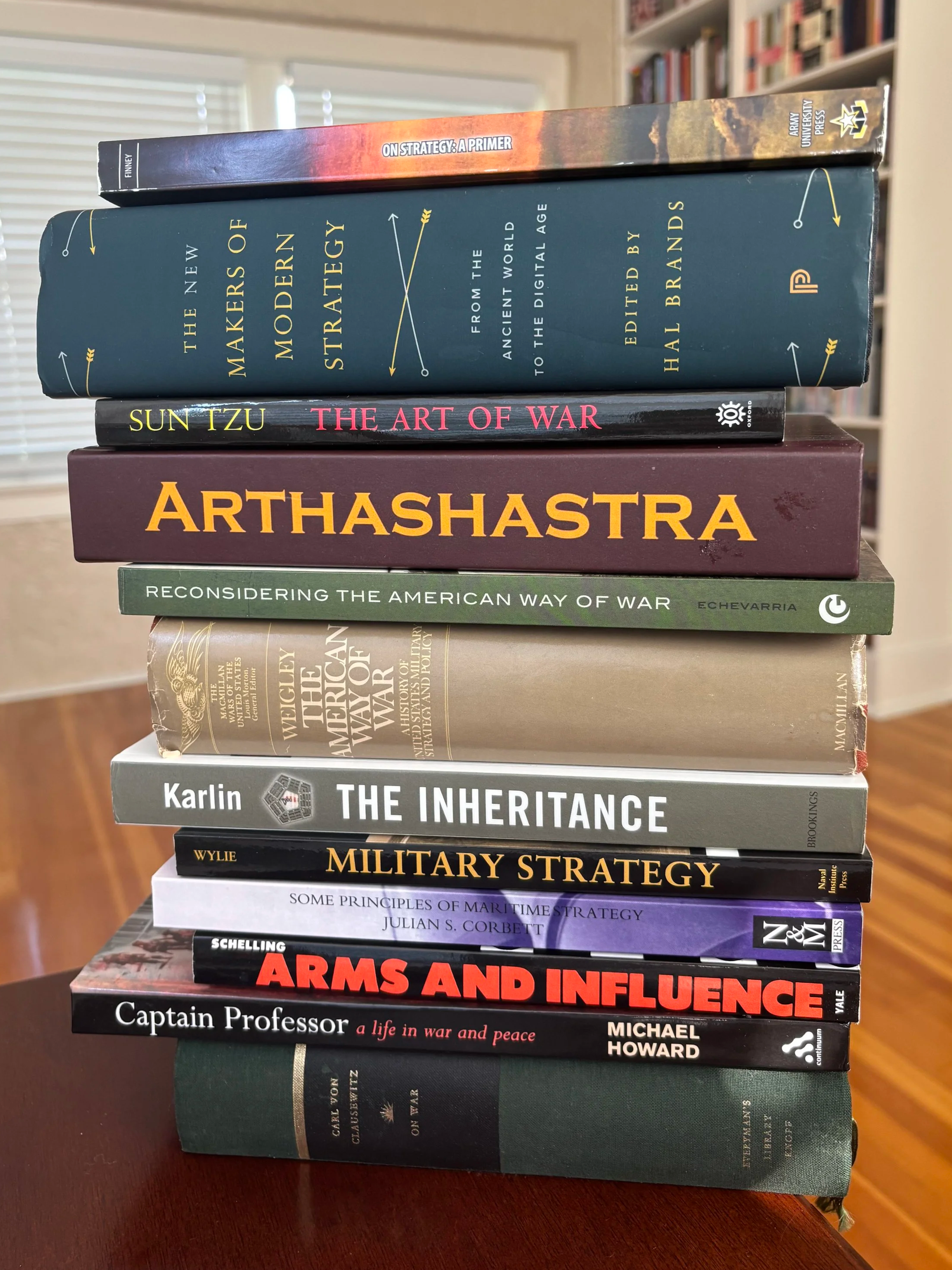
After more than a decade away from studying the fundamentals of what our new Army strategist officers (Functional Area 59, or FA59) are taught in the Basic Strategic Art Program (BSAP) at the US Army War College, I’m diving back in at my own pace. The below is a chronicle of the readings, if you want to follow along.
Note: I’ll post the major readings, but there are a host of other items that add flavor and nuance to the basic syllabus that won’t be covered here.
Week 1 - Foundations
Nathan K. Finney, On Strategy: A Primer (Leavenworth, KS: Army University Press, 2020) - focus on J.P. Clark and Francis Park, “Practical Strategists: The Perspective and Craft of the General Staff Officer,” pp. 115-126.
Hal Brands, The New Makers of Modern Strategy: From the Ancient World to the Digital Age (Princeton University Press, 2023) - focus on Lawrence Freedman, “Strategy: The History of an Idea,” pp. 17-40.
Week 2 - “Non-Western” Strategy
Hal Brands, The New Makers of Modern Strategy: From the Ancient World to the Digital Age (Princeton University Press, 2023) - focus on Toshi Yoshihara, “Sun Zi and the Search for a Timeless Logic of Strategy.”
John Sullivan, “Sun Tzu’s Fighting Words,” Strategy Bridge.
Sun Tzu, The Art of War, trans. by Samuel B. Griffith (Oxford University Press, 1963) - focus on pp. 63-110 and 144-149.
Kautilya, The Arthashastra, trans. by R. Shamasastry (Government Press, 1915) - focus on pp. 101-114, 119-120, 137-145, 158-163.
Week 3 - “Western” Strategy
Hal Brands, The New Makers of Modern Strategy: From the Ancient World to the Digital Age (Princeton University Press, 2023) - focus on Hew Strachan, “The Elusive Meaning and Enduring Relevance of Clausewitz.”
Carl von Clausewitz, On War, trans. by Michael Howard and Peter Paret (Princeton University Press, 1976) - focus on pp. 479-483, 74-104, 113-123, 357-371, 524-529, 566-573, 579-600, 605-610.
Hal Brands, The New Makers of Modern Strategy: From the Ancient World to the Digital Age (Princeton University Press, 2023) - focus on Walter Russell Mead, “Thucydides, Polybius, and the Legacies of the Ancient World.”
Thucydides, The Peloponnesian War, trans. Walter Blanco (Norton, 1998) - focus on pp. 1.22-1.23, 1.66-1.88, 5.84-5.116, 1.140-1.146 and 2.54-2.56, 5.14-5.31, 6.8-6.26 and 8.1-8.2.
Week 4 - Coercion theory
Thomas Schelling, Arms and Influence (Yale University Press, 1966). Focus on, pp. 1-18, 35-43, 69-91.
Glenn Snyder, “Deterrence and Power,” Journal of Conflict Resolution, 4 (1960), pp. 163-178.
Robert Pape, Bombing to Win: Air Power and Coercion in War (Cornell University Press, 1996) - focus on pp. 12-38.
Joint Publication 1, Vol 1, “Strategic Uses of Force,” - focus on pp. I-3 to I-5.
Matthew Jackson and Massimo Morelli, “The Reasons for War: An Updated Survey,” In The Handbook on the Political Economy of War, eds. Christopher J. Coyne and Rachel L. Mathers - pp. 34-57.
Michael Mazarr, Understanding Deterrence (RAND Corporation, 2023).
Lyle Morris, “China’s Views on Escalation and Crisis Management and Implications for the United States,” Asia Society Policy Institute (22 January 2025).
Erika Solomon, “For Iran’s Rulers, Refusing U.S. Demands is a Risk Worth Taking, New York Times (23 February 2026).